
Glastrix — UV Printing Berlin
Custom Ceramic Tile Printing: UV Direct Print for B2B in Hospitality and Retail
Custom-printed ceramic tiles for restaurants, hotels and retail — Glastrix UV-prints on ceramic from one piece, no minimum order, shipped EU-wide.
Eric Frank · Founder & CEO, Glastrix Berlin-Kreuzberg
B2B buyers who want custom-printed ceramic tiles — for a restaurant concept, a hotel renovation, or a flagship store fit-out — quickly run into a structural gap: conventional tile manufacturers supply standard product ranges and work with high minimum quantities. Custom motifs, special formats, or small runs simply aren't part of the traditional tile trade. UV direct printing on ceramic closes this gap, and has established itself as a reliable tool for interior designers, hospitality operators, and retailers who want to regain design control over their materials.
What is UV direct printing on ceramic tiles?
UV direct printing is a flatbed digital printing process: UV-curing inks are applied without any intermediate medium directly onto the surface of the material and instantly cured by UV light. Unlike screen printing, decal processes, or industrial glaze printing, no printing plates are required — the motif comes as a print file, is prepared, and is transferred directly to the tile.
The result is a mechanically stable, stain-resistant surface with precise colour reproduction down to fine details. Colour gradients, photo textures, typography, logo marks — all reproducible, tile by tile, from a single piece. For B2B buyers this means no minimum order volume, no tooling costs, and no waiting time for factory-level customisation.
Custom ceramic tile printing for B2B — typical applications
The process has established itself across several B2B segments as a practical alternative to standard product:
- Hospitality: Restaurants, bars and cafés use printed ceramic for bar backs, wall panels behind the kitchen pass, or decorative accents in the dining room. Recurring motifs, brand graphics, or location-specific illustrations are integrated permanently and hygienically into the interior concept.
- Hotels: Bathrooms, wellness areas and lobbies receive tile prints that combine corporate identity with material quality. Special formats that match exactly to existing tile patterns can be produced to order.
- Retail and shopfitting: Pop-up stores, concept stores and flagship locations use printed tiles as brand ambassadors — as floor insets, shelf backs, or plinth cladding for product presentations.
- Galleries and cultural institutions: Artists and curators use UV-printed ceramic as an exhibition medium — reproduced from digital originals, in small editions, with photorealistic accuracy.
- Interior design and architecture: Planning offices order single pieces or small series for client projects where standard product is insufficient. The ability to request a prototype first makes the process plannable and low-risk.
What to consider during production
Not every ceramic tile is immediately suitable for UV direct printing. The decisive factors are surface characteristics and glaze type. High-gloss glazes accept ink well; matte and textured surfaces require adjusted print parameters. Key points for B2B buyers:
- Material suitability: Glazed stoneware and fine stoneware with a flat surface are reliably suitable. Unglazed blanks, heavily textured tiles, or curved formats require pre-assessment.
- Format and thickness: Glastrix processes formats up to 3.20 × 2 metres seamlessly; special thicknesses on request.
- Customer-supplied material: If you have an existing tile specification, blanks can be sent directly. This maintains consistency with the existing tile layout.
- File preparation: UV direct printing works with CMYK colour profiles. Special colours (Pantone) should be pre-converted and agreed with the print studio to avoid colour deviations.
- Outdoor use: For permanent outdoor installation, contact Glastrix in advance — not all ceramic surfaces are equally suited to direct UV or weathering exposure.
Reference projects: ceramic as a design medium
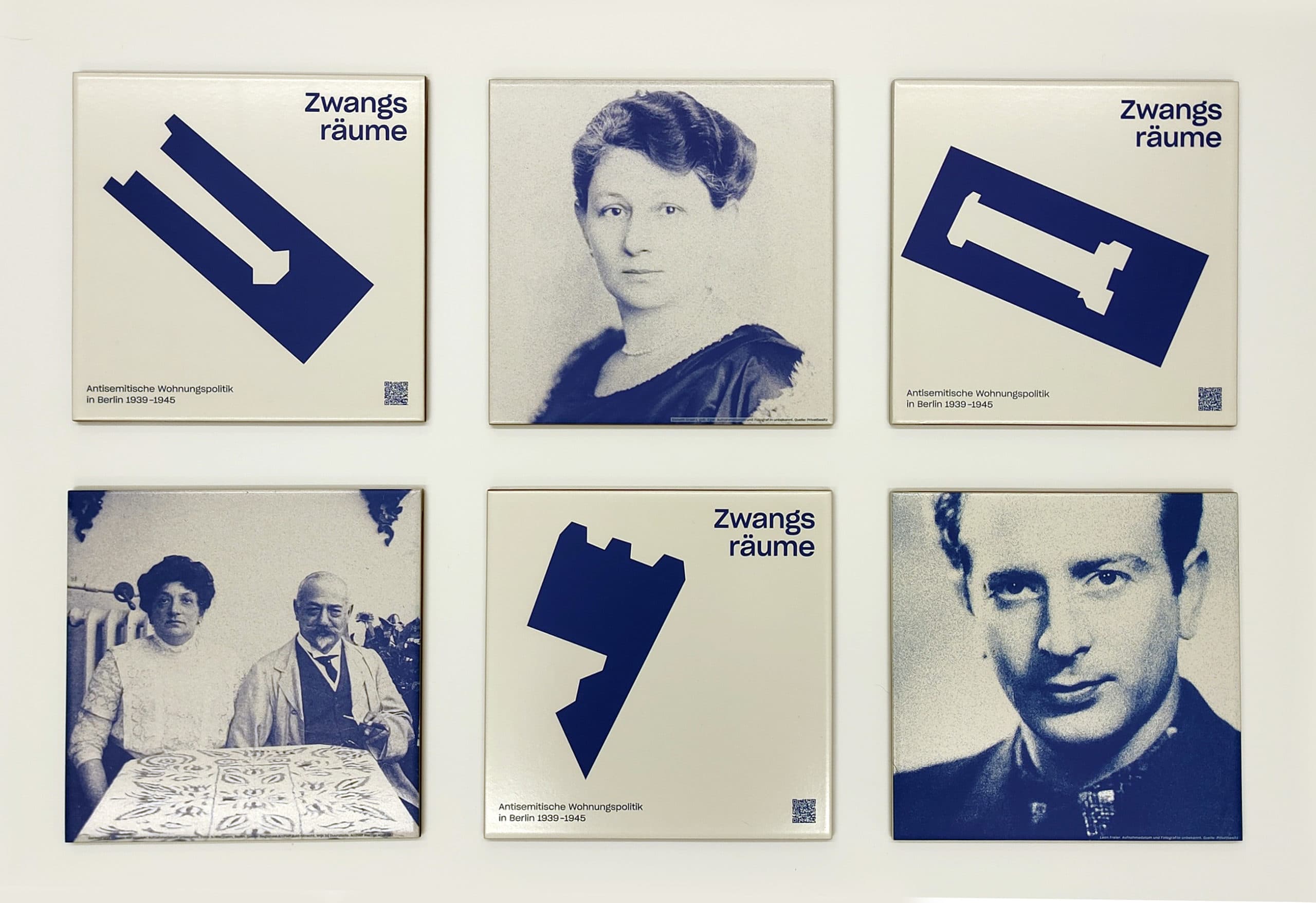
Two projects from the Glastrix portfolio illustrate the creative range of the process. In Zwangsräume, ceramic tiles were used as image carriers for an immersive art installation — each tile uniquely printed, part of a coherent visual narrative. The Ornament Control project digitally reinterprets classical bathroom tile patterns: precisely reproduced ornaments on standard-format ceramic carriers that integrate seamlessly into conventional tile layouts. Both works demonstrate that UV direct printing goes far beyond commercial labelling requirements — it is a fully-fledged design tool for interior architecture and spatial art.
Custom ceramic tile printing at Glastrix — with a free test print
Glastrix has been producing in Berlin-Kreuzberg since 2015, specialising in UV direct printing on flat materials: glass, metal, wood, acrylic — and ceramic. For B2B projects: no minimum order quantity. Single pieces for sample presentations, pilot series for the tender phase, ongoing production runs — all quantities are welcome. Delivery is EU-wide, with predictable lead times and a dedicated contact for project enquiries.
For new enquiries, Glastrix offers a free test print: send your own tile or source material through the studio, submit your print file, review the result — before any larger commission. This reduces project risk to zero and gives planners and buyers the decision basis they need for tenders and budget approvals. Enquiries are handled directly through the contact form.
Frequently asked questions: ceramic tile printing
What is UV direct printing on ceramic tiles?
UV direct printing is a flatbed digital printing process: UV-curing inks are applied without any intermediate medium directly onto the ceramic surface and instantly cured by UV light. No printing plates are required — the motif comes as a print file and is transferred directly to the tile. The result is a mechanically stable, stain-resistant surface with precise colour reproduction down to fine details, from a single piece, with no minimum order.
Which ceramic surfaces are suitable for UV printing?
Glazed stoneware and fine stoneware with a flat surface are reliably suitable. Unglazed blanks, heavily textured tiles, or curved formats require pre-assessment. Customer-supplied tiles can be sent directly to the studio to maintain consistency with existing tile work.
Is there a minimum order quantity for custom-printed ceramic tiles at Glastrix?
No. Glastrix produces custom-printed ceramic tiles from a single piece — no minimum order, no tooling costs, no factory-level lead times. For B2B buyers this means prototype samples, pilot series, and ongoing production runs are all handled the same way.
What file format and resolution are needed for ceramic tile printing?
UV direct printing works with CMYK colour profiles. Special colours (Pantone) should be pre-converted and agreed with the print studio to avoid colour deviations. For close-viewing areas 300 dpi at final print size is recommended; for larger formats viewed from a distance, 150 dpi is sufficient.
Can Glastrix print onto ceramic tiles I already own?
Yes. If you have an existing tile specification, you can send your blanks directly to the Berlin-Kreuzberg studio. Glastrix prints on customer-supplied ceramic, provided the surface and glaze type are suitable. Contact us before shipping to confirm compatibility.
Weiterführende Artikel
Custom ceramic tile printing — request a free test print
From 1 piece, no minimum order. UV direct printing on ceramic for hospitality, hotels and retail. In-house production in Berlin-Kreuzberg since 2015, EU-wide shipping.
From 1 piece · No minimum order · 48h · Berlin-Kreuzberg · EU-wide