
Glastrix — UV Printing Berlin
UV Printed Glass Tiles for Interior Design: Applications, Planning and Options
UV printed glass tiles give interior designers maximum creative freedom — made to measure, no minimum order, any size, any motif. From Glastrix Berlin.
Eric Frank · Founder & CEO, Glastrix Berlin-Kreuzberg
UV printed glass tiles are no longer a niche product in modern interior design. For architects, shopfitters, and commercial clients, they offer a way to specify surfaces precisely to a concept — with a custom motif, in any required size, on a material that is simultaneously robust, hygienic, and visually precise. The combination of printed glass tiles and interior design is most compelling where standard solutions fall short: where spaces need to be not only functional but identity-defining. This article explains when UV printing on glass is the better choice, what to consider during planning, and why the right print partner makes the difference.
What are printed glass tiles?
Printed glass tiles are glass panels — typically toughened safety glass (ESG) or laminated safety glass (VSG) — onto which motifs, colours, or graphics are applied by UV direct printing. Unlike conventional ceramic tiles with fired glazes, the UV ink sits directly on the glass surface and, once cured, is wipe-proof, scratch-resistant, and moisture-resistant. Glass also offers a decisive advantage no other tile material provides: with reverse printing, the ink is applied to the side of the panel that faces away from the viewer — protecting the ink from mechanical stress while simultaneously creating a distinctive visual depth that makes motifs appear to float beneath the glass.
The process allows virtually unlimited creative freedom: full-colour motifs, corporate designs, abstract patterns, ornaments, photographs, or monochrome surfaces. Particularly relevant for interior design: printed glass tiles can be produced in completely custom formats — with no dependency on standard dimensions or existing product ranges. This makes them suitable for unusual installation scenarios and architectural bespoke projects.
Printed glass tiles in interior design: typical applications
Applications range from private wet rooms to large-format wall designs in hospitality, retail, and hotels.
- Kitchens and splashback areas: The smooth, joint-free glass surface is ideal for kitchen splashbacks behind the hob and sink. Unlike ceramic tiles, there is no risk from grout lines that absorb moisture or are difficult to clean. A continuous printed motif can make the kitchen a designed space — from a simple concrete look to a multi-colour surface motif spanning the full wall width.
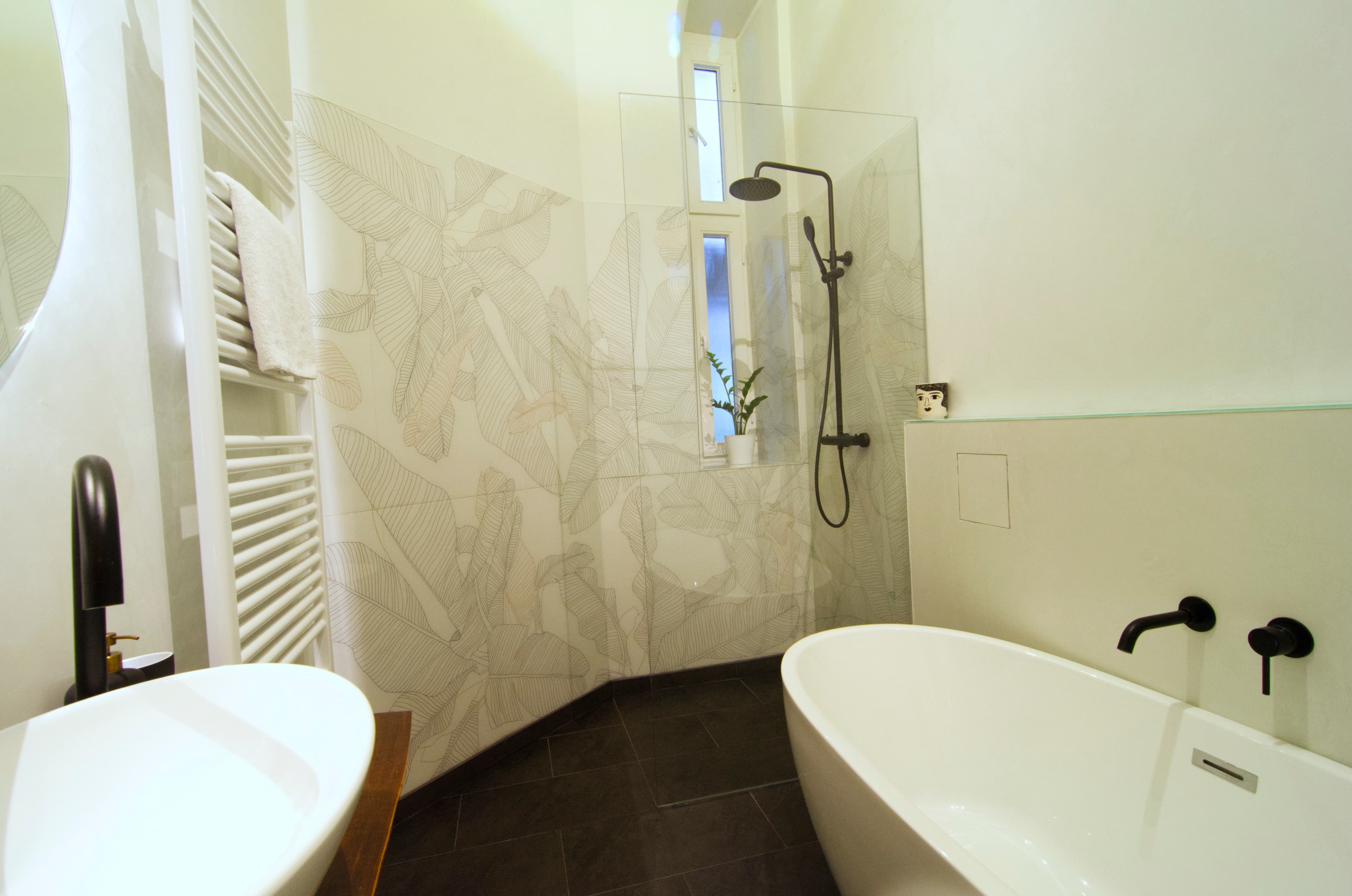
- Bathrooms and wet rooms: Shower walls, bath surrounds, or entire bathroom wall surfaces can be finished with printed glass tiles without grout interruptions. Ornamental motifs or textile textures achieve an effect that conventional materials cannot match — particularly when motif and format are coordinated.
- Hospitality and hotels: Restaurants use printed glass surfaces as wall cladding, room dividers, or bar backs — often in combination with targeted lighting. The motif can carry brand identity or contribute to the atmosphere of the space. Combined with backlighting, illuminated panels with their own luminance and high visibility at distance become possible.
- Retail and showrooms: Shopfitters use printed glass tiles to structure display areas, design changing rooms, or stage entrance areas. The durability of the material is a clear advantage over wallpaper or film solutions.
- Galleries and exhibition spaces: Glass as a print carrier refracts and reflects light in a way no other material does. Printed glass can simultaneously be a wall object and a spatial design element — an aspect that curatorial projects deliberately exploit to connect graphic art with spatial impact.
Technical planning: what architects and designers need to know
Anyone incorporating printed glass tiles into a project should know a few technical fundamentals to avoid errors in production and installation.
- Print resolution: For large-format glass surfaces, a minimum of 150 dpi at actual print size is recommended. Areas intended for close viewing — kitchen splashbacks or reception counters — should be planned at 300 dpi.
- Front or reverse printing: Depending on the installation context, printing can be on the visible face or the reverse of the glass. Reverse printing protects the ink from mechanical stress and simultaneously creates a distinctive visual depth.
- Edge processing before printing: ESG must be toughened before printing — after that, the glass cannot be cut. Dimensional accuracy when ordering is therefore essential. Deviations of even a few millimetres can necessitate complete re-manufacture.
- Fixing and construction: Point fixings, U-profiles, clamp profiles, or full-surface adhesive mounting — the fixing method affects glass thickness, the print margin from the edge, and installation depth. This coordination should happen before print approval to avoid retrospective corrections.
- Colour accuracy: UV printing on glass is reproducible, but a physical colour sign-off sample is recommended for sensitive colours — corporate colours, skin tones, or coordinated room colour concepts — before the main production run begins.
Quality and durability in commercial use
UV-cured inks on glass are designed for permanent use: resistant to standard cleaning agents, moisture, and everyday mechanical stress. For wet rooms and kitchen environments, this is a decisive advantage.
Compared to adhesive film or wallpaper solutions, printed glass has a clear structural advantage: no butt joints, no air bubbles, no delamination risk — and the surface remains fully wipe-proof and suitable for disinfectants for years. For hospitality and healthcare environments where hygiene standards are part of the operating concept, this is a material argument.
Ordering printed glass tiles: the Glastrix offer
Glastrix has been producing UV prints on glass at its Berlin-Kreuzberg studio since 2015, supplying interior design practices, shopfitters, hospitality outfitters, and B2B clients across the EU. Every order can be a single panel or a complete project series — there is no minimum order and no standard size dependency.
- Custom manufacture in any required size, including oversized formats
- Short lead times: printing and dispatch within 48 hours of print approval
- White-label fulfilment: direct delivery to end customers without Glastrix branding on request
- Material range: alongside glass, UV printing on wood, metal, acrylic, ceramic, copper, and mirror
For projects where colour accuracy or surface quality needs to be assessed before the main production run, Glastrix offers a free test print. This allows material, motif, and colour rendering to be evaluated in the space before production begins. Enquiries can be made directly via /anfragen — no minimum volume, no long lead time.
Printed glass tiles — from our studio
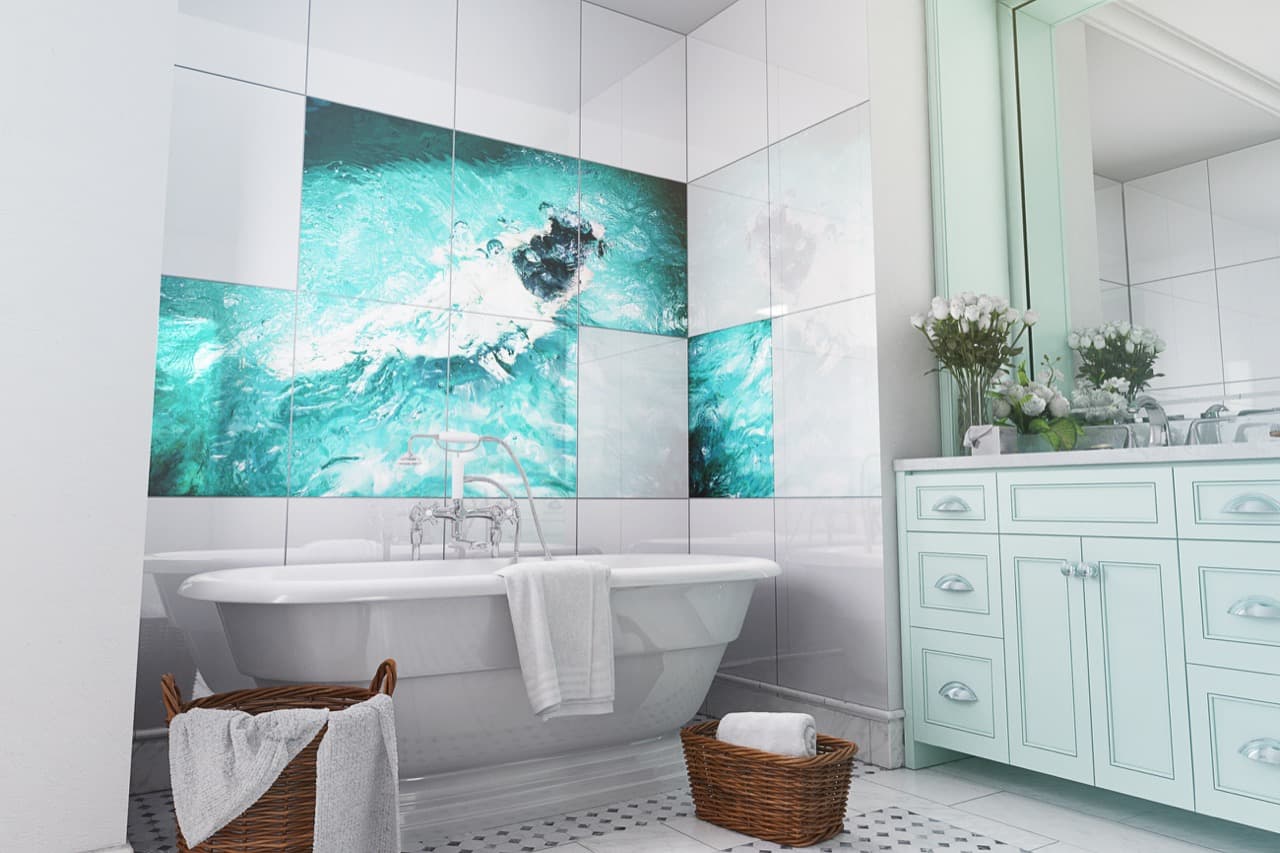
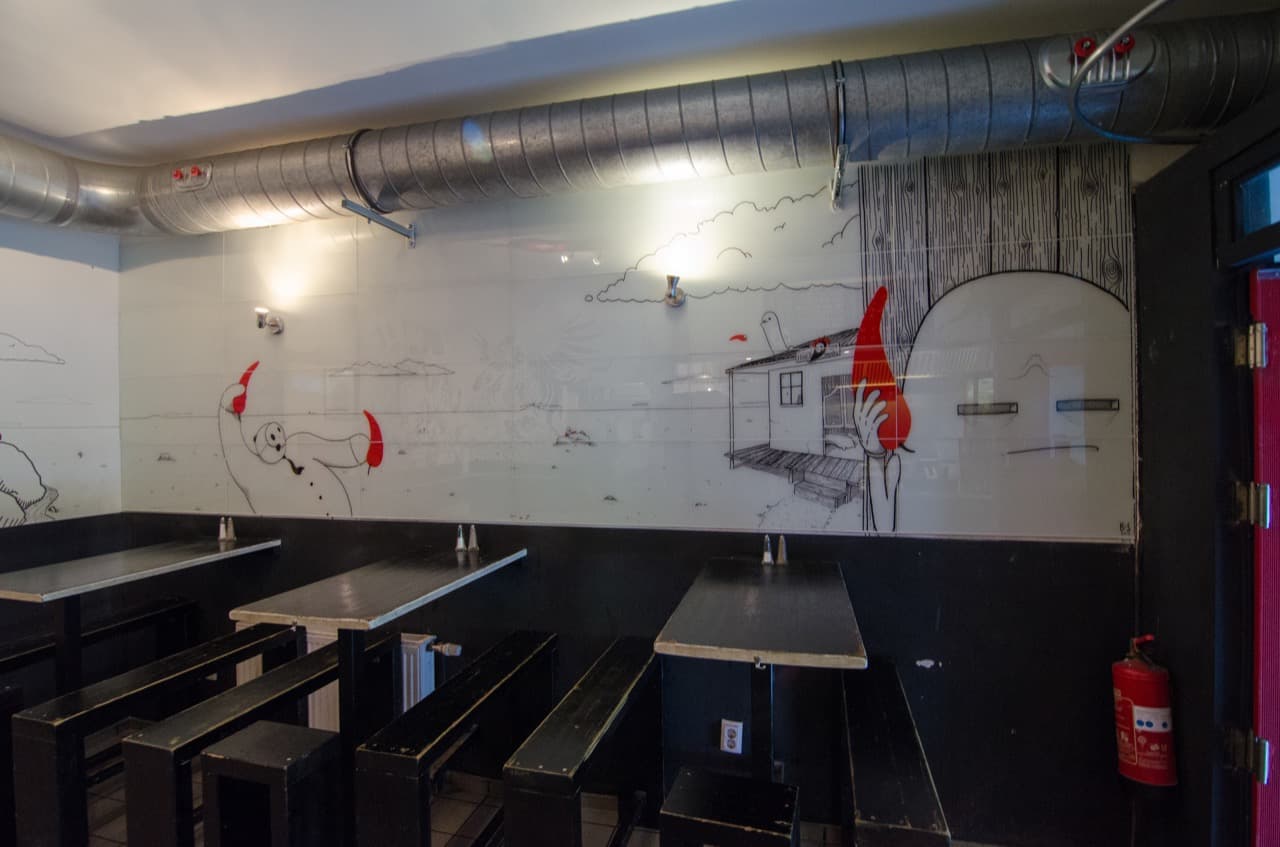
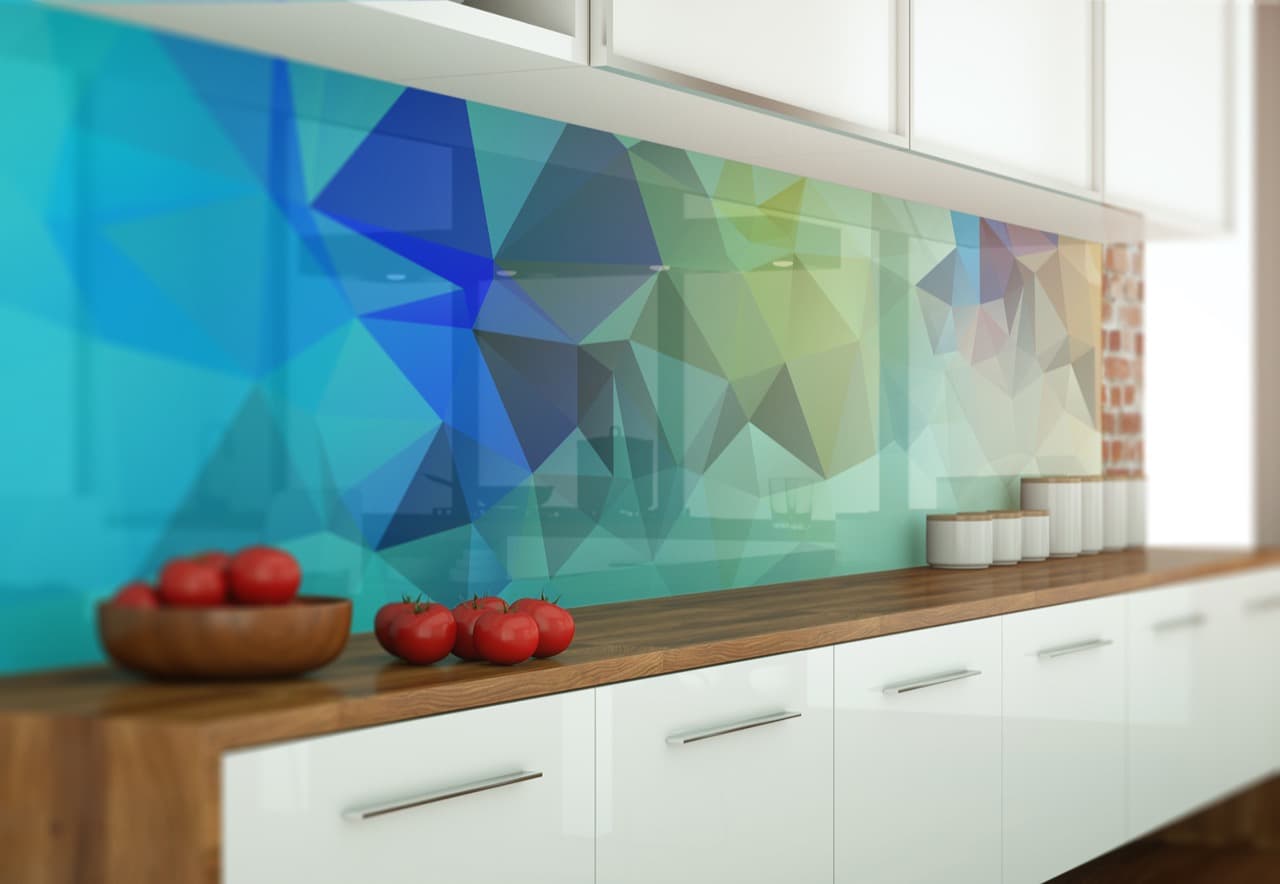
UV direct printing on glass — from kitchen splashbacks to bathroom walls. Produced in-house in Berlin-Kreuzberg, from one piece, no minimum order.
Request a free test printFrequently asked questions: UV printed glass tiles
What are UV printed glass tiles and how are they made?
UV printed glass tiles are glass panels — typically toughened safety glass (ESG) or laminated glass (VSG) — onto which custom motifs, colours, or graphics are applied by UV direct printing. The UV ink adheres directly to the glass surface and is cured by ultraviolet light: no film, no adhesive, no intermediate layer. The result is wipe-proof, scratch-resistant, and moisture-resistant. Glastrix produces all printed glass tiles in-house in Berlin-Kreuzberg, from one piece, with no minimum order.
Which interior spaces are best suited to printed glass tiles?
Printed glass tiles are most commonly used in kitchens (splashbacks), bathrooms (shower walls, bath surrounds), hospitality (wall cladding, bar backs), retail (showrooms, changing rooms), and office reception areas. They are the right choice wherever standard tiles offer insufficient design freedom and the material needs to be durable, hygienic, and fully customisable.
Can printed glass tiles be used in wet rooms and bathrooms?
Yes. UV direct printing on glass is moisture-resistant and fully suitable for bathrooms, showers, and wet rooms. Important: the glass must be toughened (ESG) before printing — it cannot be cut afterwards. Exact dimensions must therefore be specified before production begins.
What resolution do I need for printed glass tiles?
For close-viewing areas — kitchen splashbacks, bathrooms — 300 dpi at final print size is recommended. For larger wall surfaces viewed from further away, 150 dpi is sufficient. Glastrix checks every print file before production and flags any quality issues proactively, before any material is manufactured.
Is there a minimum order quantity for printed glass tiles at Glastrix?
No. Glastrix produces printed glass tiles from a single piece — no minimum order, no entry-level pricing tiers. This makes the process economically viable for architects and interior fit-out specialists even for prototypes, sample orders, and one-off projects.
Weiterführende Artikel
UV printed glass tiles — request a free test print
From 1 piece, no minimum order. UV direct printing on glass for kitchens, bathrooms, hospitality and more. Produced in-house in Berlin-Kreuzberg since 2015, shipped EU-wide.
From 1 piece · No minimum order · 48h · Berlin-Kreuzberg · EU-wide